
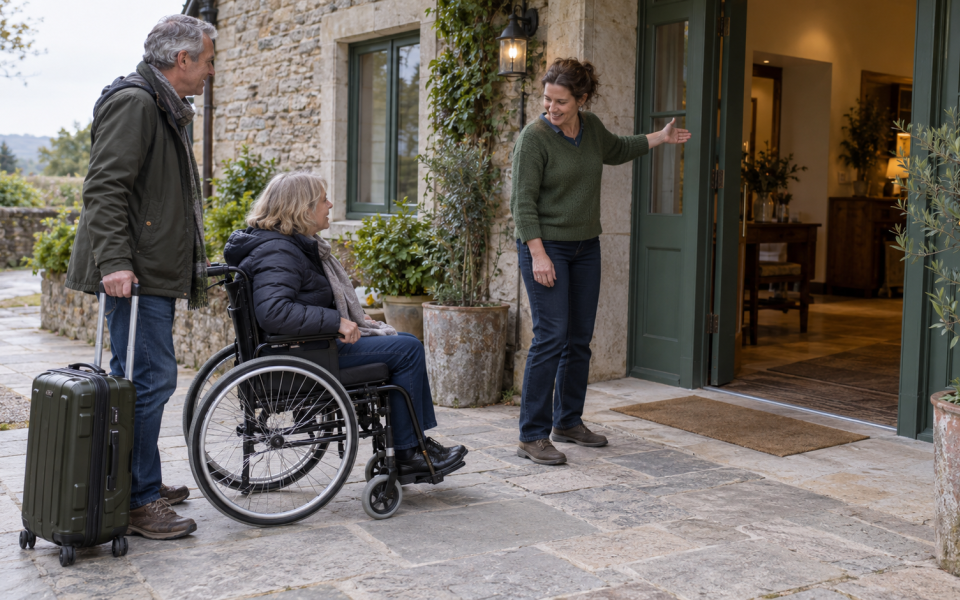
Planning a trip often starts with a very practical question: will this place really suit me? For a person with a disability, an imprecise description can leave many questions unanswered. The presence of a lift, for example, does not on its own explain the route from the street to the accommodation or the equipment available inside.
For accommodation professionals, improving the welcome therefore begins with reliable information. Not with reassuring wording, but with details that travellers can understand, check and use to make a decision.
Describe the premises rather than make promises
A general description such as “accessible” remains difficult to interpret without further details. Are there steps at the entrance? Does the route involve a heavy door? How do guests reach the bathroom? What equipment is actually present?
The aim is not to improvise an expert assessment. It is to distinguish between observed features, documented information and points that need checking. A measurement should not be guessed, and a photograph does not replace a clear description. If an answer is missing, it is better to say so and then find it than to let travellers organise their stay on the basis of an assumption.
Consider a range of needs
Accessibility is not only about moving around. Understanding instructions, being able to read a document easily or having the option to communicate in writing can also matter to the guest experience.
The French approach notably brings together Tourisme & Handicap, a label for tourism establishments, and Destination pour tous, a destination-level label. The revamp presented by the Directorate General for Enterprise on 6 March 2025 highlights how they complement each other and take different disabilities into account. These schemes do not automatically establish an accommodation’s accessibility status: each establishment must describe its actual situation.
Keep the listing consistent with conditions on site
Useful information must still be accurate on arrival day. A passageway may become obstructed, equipment may be moved or an access procedure may change after the listing has been written.
A simple approach is to keep a reference sheet for each property, record the dates of checks and arrange for information materials to be updated whenever something changes. On-site teams can report any discrepancies they observe without having to assess the overall compliance of the premises themselves.
When a traveller expresses a need, the conversation can stay focused on what is necessary to prepare for their arrival. There is no need to ask for a medical diagnosis to find out whether they prefer written instructions or a detailed description of the entrance route.
Make instructions easy to use
Before a stay, structured instructions can help prevent difficulties: a step-by-step guide, simple wording and a clearly identified way to get in touch. Essential information is best made available as text, rather than only in an image or video.
On site, the team should be able to find the same version of the instructions. This consistency prevents one contact from offering an option that another cannot confirm. In January 2025, the DGE also devoted an event to the role of tourism data in accessibility, highlighting the place of information in this journey.
Start with a scope that can be checked
A useful first step might focus on a few properties: reread the descriptions, identify missing information, check the instructions and agree on an update process. These organisational suggestions replace neither a specialist assessment nor the rules applicable to each establishment.
Quality hospitality is also built through these details. Giving travellers the means to decide based on precise information, then keeping that information up to date, is already a concrete step forward.