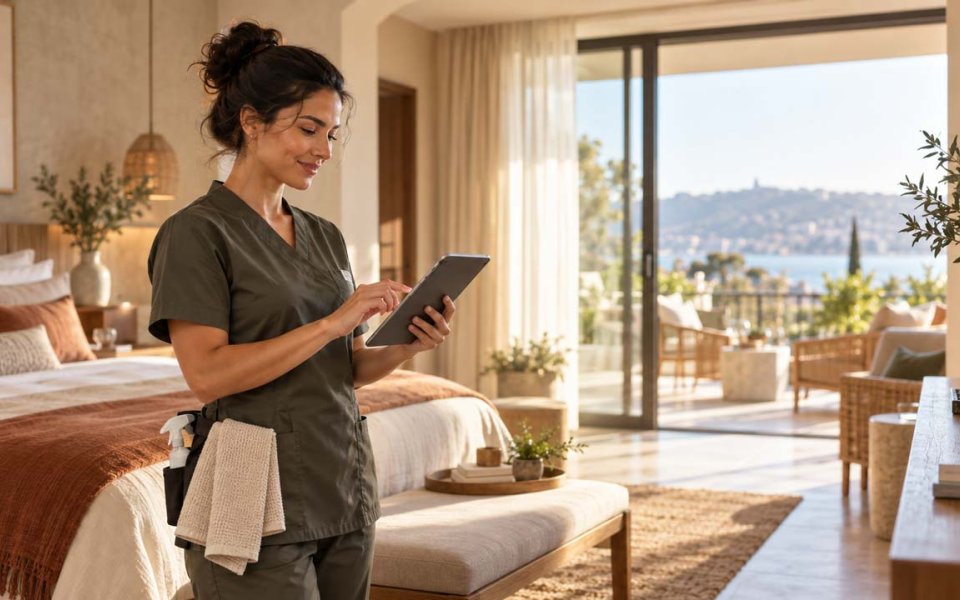
Artificial intelligence will not replace cleaning professionals — it will transform their work
AI does not remove the need for cleaning professionals. It automates coordination, quality control and reporting so field work can become smoother, more skilled and more valued.
Artificial intelligence is already transforming a large part of office work. In professional cleaning, the shift looks very different. AI does not clean a kitchen, make a bed or reliably notice every broken handle. What it can do is remove a significant amount of friction around each job.
Cleaning remains deeply human work
Cleaning a property requires observation, judgement, precision and constant adaptation. Two identical apartments on paper can require very different interventions depending on how guests left them, the time available before the next arrival or the specific characteristics of the property.
That is why automation does not mean removing the professional. It means allowing technology to take over repetitive tasks so cleaners can focus on what they do best: the work on site.
What AI can actually automate
A large share of the work surrounding a cleaning task is not cleaning at all. Someone has to receive information, understand priorities, check timings, obtain access instructions, report issues, submit evidence, answer messages and confirm completion.
A well-integrated AI system can prepare instructions, remind workers of timings, centralize access information, detect inconsistencies in reports, summarize incidents, check that a checklist is complete and generate a clear report for the property manager.
The outcome is straightforward: less time lost in coordination and more time spent on useful work.
AI as the professional’s copilot
The most credible model is augmentation, not replacement. The professional remains responsible for execution. AI becomes a copilot that can deliver the right information at the right moment.
In a short-term rental environment, for example, it can flag an early guest arrival, a room requiring special attention or an appliance that had already been reported as faulty during the previous turnover.
Less administration, more value
Cleaning professionals do not need another piece of software that adds screens and complexity. They need tools that genuinely simplify the working day.
When technology automates administration, coordination and part of the control process, work becomes smoother. Professionals can move from one job to the next with clearer information, better schedule visibility and less uncertainty.
The future of cleaning will be human and technological
The industry is not moving toward a world without cleaning professionals. It is moving toward a world in which the best professionals are better equipped.
Smartphones, optimized routes, digital protocols, automated access, proof of completion, real-time assistance and artificial intelligence will gradually become standard tools of the trade.
At StayClean, we see this evolution as an opportunity: use technology to make operational friction disappear, not the people who perform the work. Cleaning remains a field profession, but it is becoming more connected, more measurable and more professional.
Artificial intelligence is already transforming a large part of office work. In professional cleaning, the shift looks very different. AI does not clean a kitchen, make a bed or reliably notice every broken handle. What it can do is remove a significant amount of friction around each job.
Cleaning remains deeply human work
Cleaning a property requires observation, judgement, precision and constant adaptation. Two identical apartments on paper can require very different interventions depending on how guests left them, the time available before the next arrival or the specific characteristics of the property.
That is why automation does not mean removing the professional. It means allowing technology to take over repetitive tasks so cleaners can focus on what they do best: the work on site.
What AI can actually automate
A large share of the work surrounding a cleaning task is not cleaning at all. Someone has to receive information, understand priorities, check timings, obtain access instructions, report issues, submit evidence, answer messages and confirm completion.
A well-integrated AI system can prepare instructions, remind workers of timings, centralize access information, detect inconsistencies in reports, summarize incidents, check that a checklist is complete and generate a clear report for the property manager.
The outcome is straightforward: less time lost in coordination and more time spent on useful work.
AI as the professional’s copilot
The most credible model is augmentation, not replacement. The professional remains responsible for execution. AI becomes a copilot that can deliver the right information at the right moment.
In a short-term rental environment, for example, it can flag an early guest arrival, a room requiring special attention or an appliance that had already been reported as faulty during the previous turnover.
Less administration, more value
Cleaning professionals do not need another piece of software that adds screens and complexity. They need tools that genuinely simplify the working day.
When technology automates administration, coordination and part of the control process, work becomes smoother. Professionals can move from one job to the next with clearer information, better schedule visibility and less uncertainty.
The future of cleaning will be human and technological
The industry is not moving toward a world without cleaning professionals. It is moving toward a world in which the best professionals are better equipped.
Smartphones, optimized routes, digital protocols, automated access, proof of completion, real-time assistance and artificial intelligence will gradually become standard tools of the trade.
At StayClean, we see this evolution as an opportunity: use technology to make operational friction disappear, not the people who perform the work. Cleaning remains a field profession, but it is becoming more connected, more measurable and more professional.
About William Rudent
Editor at StayClean
Editorial expertise
Publication date
Wednesday, September 16, 2026
Reading language
English
William Rudent est cofondateur de StayClean. Passionné par la tech, l’hospitality et les nouveaux usages, il partage ici son expérience de terrain, ses réflexions et sa vision d’un secteur du ménage qui évolue, se professionnalise et se réinvente.
artificial intelligence
cleaning professionals
automation
housekeeping
technology
hospitality
field work
StayClean